


💡 Key Takeaways
- Weight Ratios Dictate Stability: The Saramonic Air SE’s 5g transmitter offers superior stability on thin fabrics compared to the 8g Hollyland Lark A1, preventing garment sagging.
- SNR is the Foundation of Audio Clarity: With an 80dB Signal-to-Noise Ratio, the Air SE provides a significantly cleaner noise floor in quiet environments than the Lark A1.
- AI Algorithms Redefine Voice Isolation: Unlike traditional frequency filtering, AI-driven noise reduction handles unpredictable environmental sounds with much greater naturalness.
- Redundant Tracks Provide the Ultimate Safety Net: The inclusion of a Safety Track in the Air SE provides a critical backup for unpredictable high-dynamic range recording scenarios.
In the rapidly evolving landscape of mobile content creation, lightweight wireless microphones have shifted from a luxury to a necessity. However, the true challenge for manufacturers lies in balancing extreme portability with professional-grade audio fidelity. The new Saramonic Air SE and the popular Hollyland Lark A1 represent two distinct philosophies in the wireless microphone system space: one pushes the boundaries of AI noise cancellation and weight reduction, while the other focuses on battery endurance and a mature ecosystem. Our deep dive reveals that the 3-gram difference on the spec sheet points to a fundamental divergence in recording strategy.
Why 5 Grams is a Threshold for Stability
The physical weight of a transmitter directly impacts the visual quality of a video by preventing garment sagging and collar displacement.
In real-world usage, the Saramonic Air SE’s 5g body exerts almost zero pull on a collar, whereas the 8g Lark A1, though light by industry standards, can cause slight tilting on silk or ultra-thin T-shirts. As the creator noted in the comparison:
"While that difference of 3 g may sound minor, it becomes more apparent when the microphone is attached to thin clothing, where the lighter Air SE tends to pull less on fabric and stays more stable."
This competition over grams isn't just "spec-chasing"; it’s a calculated move regarding the Center of Mass. For vloggers, microphone stability is a visual cue of production quality. While the Air SE trades some battery capacity for this lightness, it gains a lower visual profile, making it easier to "hide" in wide shots without distracting the audience.
Signal Quality: How SNR Influences Post-Production
A higher Signal-to-Noise Ratio (SNR) in quiet environments translates to a cleaner noise floor, providing more headroom for professional editing and gain adjustments.
Comparing the hardware specs, the Air SE features an SNR of ≥80dB, while the Lark A1 sits at ≥67dB. In practical tests, the creator emphasized:
"As a result, in practical terms, a higher SNR means less background hiss when recording in quiet environments. So, when dialogue is captured in a controlled indoor space, the Air SE recording tends to sound cleaner even before any editing or noise reduction is applied. This becomes especially noticeable during voice-overs or interviews where silence between words is clearly audible. "
While overall "audio character" is influenced by frequency response and compression strategies, SNR remains the baseline of signal integrity. A lower noise floor means that when you apply gain or compression in post-production, you aren't simultaneously amplifying an annoying "hiss." For podcasts or indoor interviews, the Air SE’s hardware provides a superior raw canvas, allowing for more aggressive tonal shaping without degrading the signal.

AI Noise Cancellation vs. Traditional ENC
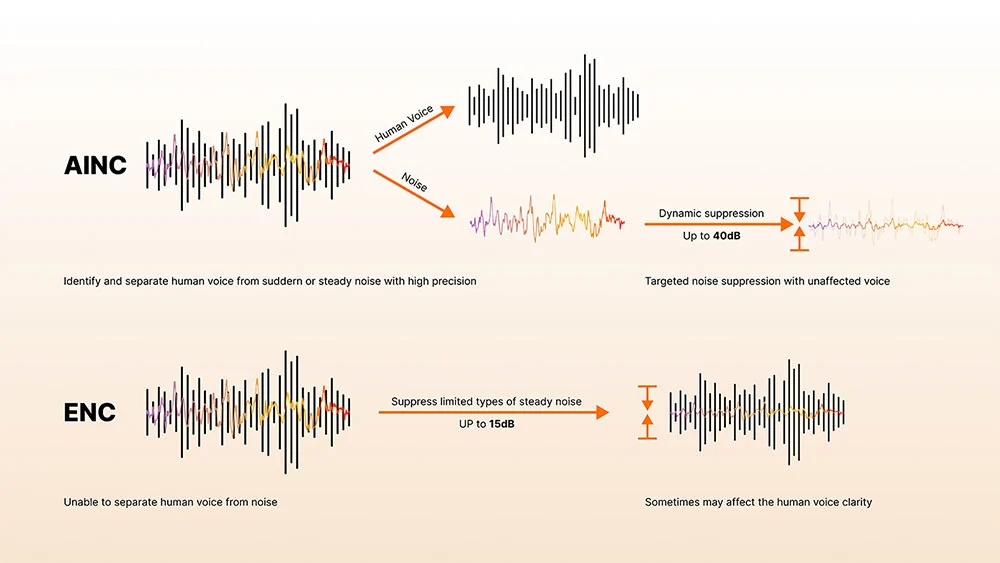
AI-driven deep learning algorithms are significantly more effective at isolating human speech from unpredictable background noise than traditional frequency-based filtering.
The Hollyland Lark A1 utilizes a proven three-level Environmental Noise Cancellation (ENC) system, whereas the Saramonic Air SE wireless microphone introduces AI Noise Cancellation capable of a 40dB reduction. Real-world testing shows that the AI system identifies audio patterns rather than just cutting frequencies. The review points out:
"Because this system analyzes voice characteristics rather than simply filtering frequencies, it tends to perform more consistently when noise is unpredictable, such as keyboard clicks, sudden voices, or changing street ambience. Therefore, in fast-changing environments, that adaptive behavior can produce more natural speech compared to traditional ENC processing."
Traditional Active Noise Control (ENC) often results in a "robotic" or muffled vocal tone when pushed to its limits. The value of AI lies in its ability to distinguish between human vocal cords and external sounds like keyboard clicks or traffic in real-time, preserving the natural texture of the voice while muting the chaos around it. This represents a generational shift from "filtering" noise to "reconstructing" speech.
The Final Line of Defense: Safety Track vs. Limiters
Safety Track and Limiters serve different purposes; a dedicated backup track offers higher recovery potential for unpredictable audio spikes than real-time peak suppression.
The Air SE features a "Safety Track" mode, recording a second channel at a lower volume level. The creator notes:
"This feature becomes particularly useful when speakers suddenly raise their voice or when recording in dynamic environments where levels are difficult to predict. Even if the main track distorts, the backup channel usually remains usable."
While the Lark A1 includes a Limiter for real-time peak suppression, a Safety Track provides a physical redundancy that a software limiter simply cannot match if the hardware capsule itself reaches its physical limit.
- The Technical Distinction: A Limiter is a dynamic processor that clamps down on peaks to prevent digital clipping; a Safety Track is a redundant recording (usually at -6dB) that acts as a "life insurance policy" for your audio.
- User Value: If a subject suddenly laughs or screams, causing the main track to "clip" or distort, the -6dB backup allows you to swap the audio in post-production seamlessly. This is indispensable for non-repeatable run-and-gun interviews where you only get one chance to capture the moment.
Core Capability & Hardware Comparison
| Feature | Saramonic Air SE | Hollyland Lark A1 |
|---|---|---|
| Transmitter Weight | 5g (Ultra-Light) | 8g |
| Signal-to-Noise Ratio | 80dB (Higher Clarity) | 67dB |
| Noise Reduction Tech | AI-Based Intelligent Isolation | 3-Level ENC (Frequency Filter) |
| Redundancy | Safety Track (-6dB) | Built-in Limiter |
| TX Battery Life | Approx. 6 Hours | Approx. 9 Hours |
| Charging Case Design | Open-case Design (Transformable into a handheld stick) | Closed-case Design (Full physical protection) |

Final Verdict: Which One Should You Choose?
Choose the Saramonic Air SE if you:
- Prioritize Ultra-Lightweight Gear: Ideal for creators seeking the best budget wireless microphone for thin or delicate fabrics (like silk or light T-shirts) where minimal garment pull is essential.
- Shoot Vlogs on the Go: Perfect for mobile creators who need a discreet profile and frequently move between different locations.
- Demand Natural Voice Quality: Best if you want AI-driven noise reduction that preserves vocal textures without the "robotic" artifacts of traditional filters.
- Value Audio Redundancy: Essential for those who want the "Safety Track" feature to protect against unexpected audio clipping in dynamic environments.
Choose the Hollyland Lark A1 if you:
- Perform Long-form Live Streams: The 9-hour single-charge runtime is a significant advantage for creators who can't stop to recharge mid-session.
- Record in Fixed or Controlled Scenarios: Perfect if the weight on the collar is less of a concern than absolute battery endurance.
Editor’s Notes & Pro Tips
1. The Battery Trade-off: The Air SE's weight reduction comes directly from a smaller physical battery. While the receiver is powered by the phone (saving you one device to charge), the transmitters require more frequent top-ups. If you have a full day of shooting, utilize the charging case during every break.
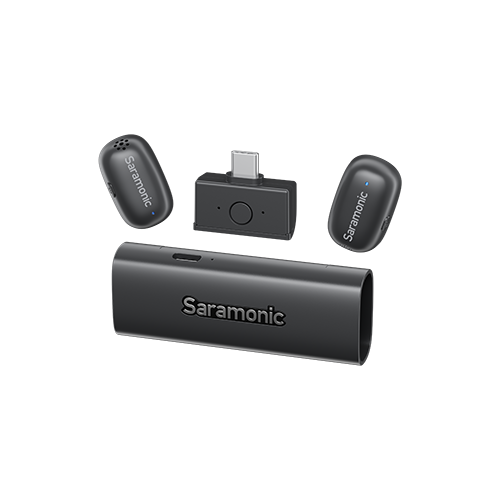
2. Handheld Versatility: The Air SE’s open-case design allows the transmitter to stay plugged into the case, effectively turning it into a short handheld "interview stick." This is a brilliant ergonomic touch for quick "man-on-the-street" segments where clipping a mic isn't practical.
3. App Integration: Use the dedicated apps for both. The Air SE allows for low-cut filtering at the source, which is much more effective at removing wind rumble than trying to fix it in a mobile editing app later. Pre-processing at the hardware level always yields more natural results.
If you’re ready to find the right fit, explore Saramonic’s full range of wireless microphone solutions—from beginner-friendly options to professional production systems.
To learn more about the latest news from Saramonic, join in our official social media: Facebook, Youtube, Instagram, X, Facebook Group.
FAQ
Is the 5g weight of the Saramonic Air SE actually noticeable?
Yes, it is the primary differentiator for stability on thin fabrics. On lightweight summer shirts, 5g stays upright and flush against the body, whereas 8-10g transmitters often pull the collar down, causing the mic to point away from the mouth and degrading audio quality.
Can I use the Saramonic Air SE for long live streams?
It is possible, but less ideal than the Lark A1 due to battery constraints. With AI noise reduction active, the Air SE battery life drops to about 4.5 hours. For 5+ hour streams, the Hollyland's 9-hour runtime provides much better peace of mind.
Does AI Noise Cancellation make the voice sound "fake"?
Generally, no; it often sounds more natural than traditional filters. AI noise reduction is actually better at preserving vocal clarity than traditional ENC because it "recognizes" the voice pattern rather than just cutting high or low frequencies. It avoids the "underwater" sound often associated with aggressive noise suppression.
What is a Safety Track and why do I need it?
A Safety Track is a redundant recording made at a lower volume level to prevent digital clipping. It ensures that if the speaker suddenly shouts and "breaks" the audio on the main track, you have a clean, undistorted -6dB backup to use in editing. This is a pro-level feature typically found in much more expensive systems.