
💡 Key Takeaways
- The Saramonic WiTalk9 X maintained reliable communication throughout most of the concert rehearsal, even in challenging acoustic conditions.
- Thick stone walls proved to be a bigger challenge than digital interference.
- Voice communication remained reliable even when crew members moved across different areas of the venue.
- AI Noise Cancellation provided limited benefits in an extremely loud live music environment.
- Communication challenges were primarily caused by environmental noise and extreme distance rather than wireless interference.
Wireless intercom systems are often tested in ideal conditions, but real productions rarely happen in ideal environments.
In a recent field test, content creator Photo Joseph used the Saramonic WiTalk9 X while filming a live concert rehearsal inside a historic monastery converted into an event venue. The location presented several challenges that commonly affect wireless communication systems, including exceptionally thick walls, multiple rooms, heavy digital equipment usage, and high sound pressure levels from a live performance.
Rather than focusing on specifications, the test explored a more practical question:
Can a wireless intercom system still deliver reliable communication when a production team is working inside a noisy and complex environment?
The results provided valuable insights for filmmakers, event crews, and production teams considering a professional wireless communication system.
What Is the Saramonic WiTalk9 X?
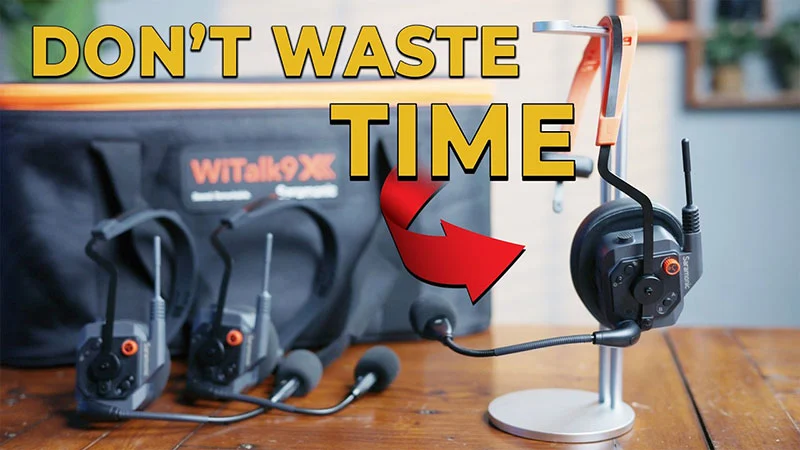
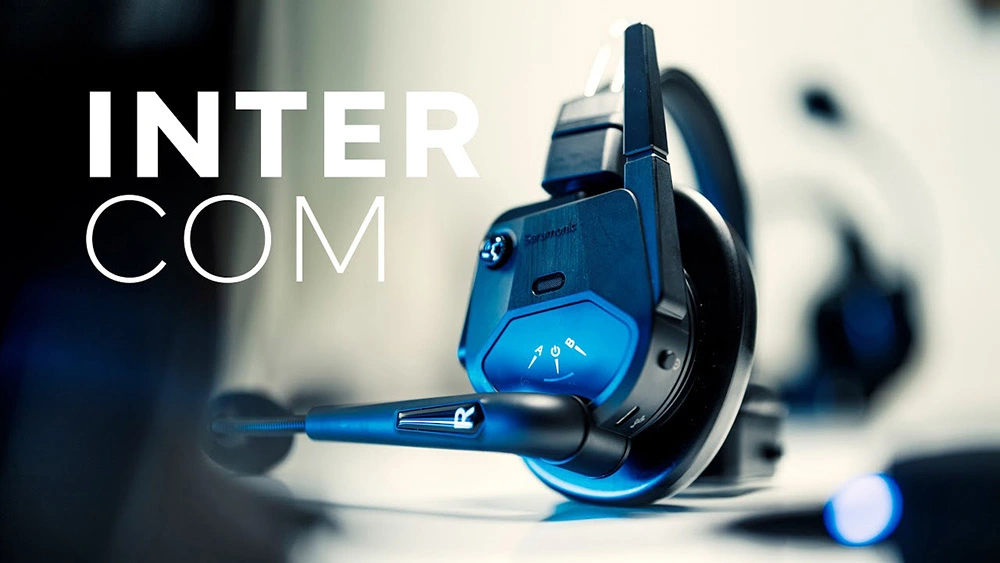
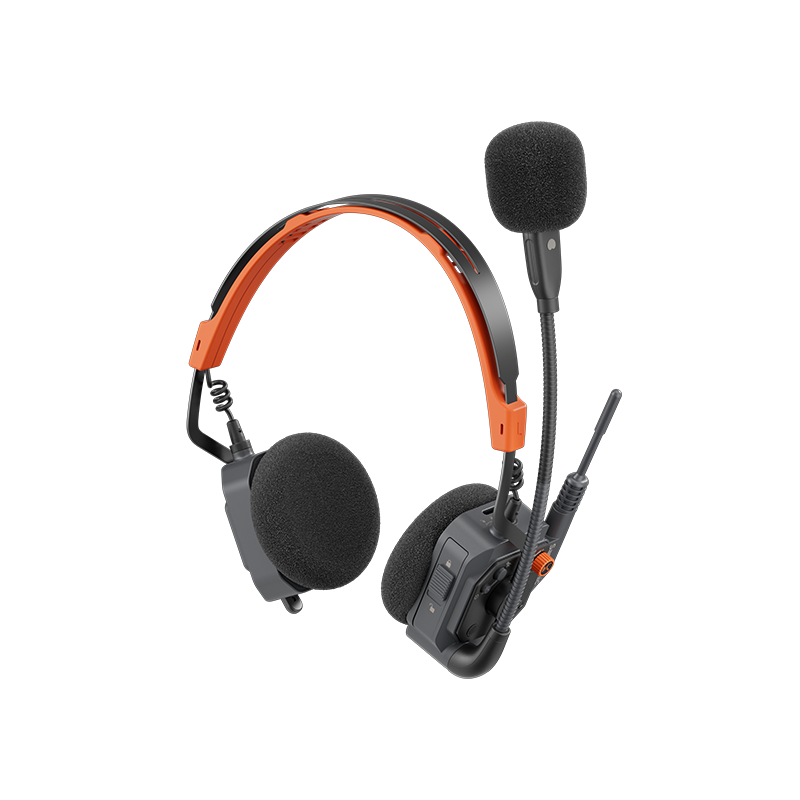
The Saramonic WiTalk9 X is a full-duplex wireless intercom system designed for film crews, live events, sports productions, houses of worship, and other professional communication workflows.
Unlike traditional communication headsets, the WiTalk9 X features a modular design that allows users to switch between single-ear, dual-ear, and helmet-ready configurations depending on the shooting environment and operational needs.
The system supports up to nine users in a hub-free setup and can be expanded for larger productions when paired with the WiTalk BASE system. It also introduces several upgrades over previous generations, including a lighter headset design, dual-antenna transmission architecture, ClearTalk™ 2.0 AI Noise Cancellation, A/B group communication, app-based control, and weather-resistant construction.
Other notable features include:
- Up to 400 m (1,300 ft) communication range
- Full-duplex communication for hands-free operation
- ClearTalk™ 2.0 AI Noise Cancellation
- Dual-antenna architecture for improved signal stability
- A/B group communication modes
- App-based control and system management
- IPX4 weather resistance
- Lightweight headset design for extended wear
- Flip-to-mute microphone operation
- Compatibility with WiTalk BASE for expanded communication networks
On paper, the WiTalk9 X appears well suited for demanding production environments. The purpose of this test was to find out whether those features would make a meaningful difference during a real-world event where noise, distance, and physical obstacles could easily disrupt communication.
Can a Wireless Intercom System Survive a Loud Concert Environment?
A live concert rehearsal is one of the most demanding communication environments for any crew.
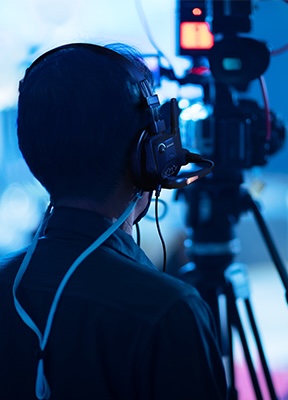
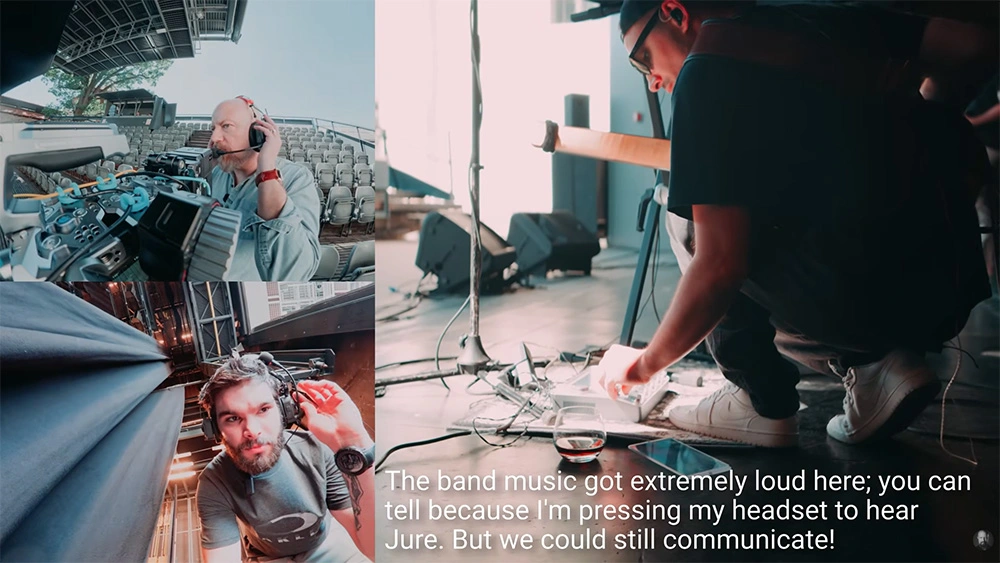
The production involved multiple camera operators spread throughout the venue while a live band performed on stage. Throughout the rehearsal, crew members relied on the WiTalk9 X to coordinate camera positions, movement, and coverage.
"It's amazing how well I can hear you guys."
One of the most revealing moments came when Reviewer expressed genuine surprise at how clearly crew members could still communicate despite the volume of the performance happening around them.
This wasn't a controlled studio environment. The team was operating in a venue filled with stage monitors, drum kits, PA systems, and constant movement.
Under these conditions, maintaining usable communication is often more important than achieving perfect audio quality.
The test suggested that the WiTalk9 X was generally able to provide dependable communication when it mattered most. Crew members were generally able to exchange instructions, confirm positions, and coordinate movements despite the challenging environment.
How Well Did the WiTalk9 X Perform Through Thick Walls?
Physical barriers are one of the most common challenges for wireless communication systems.
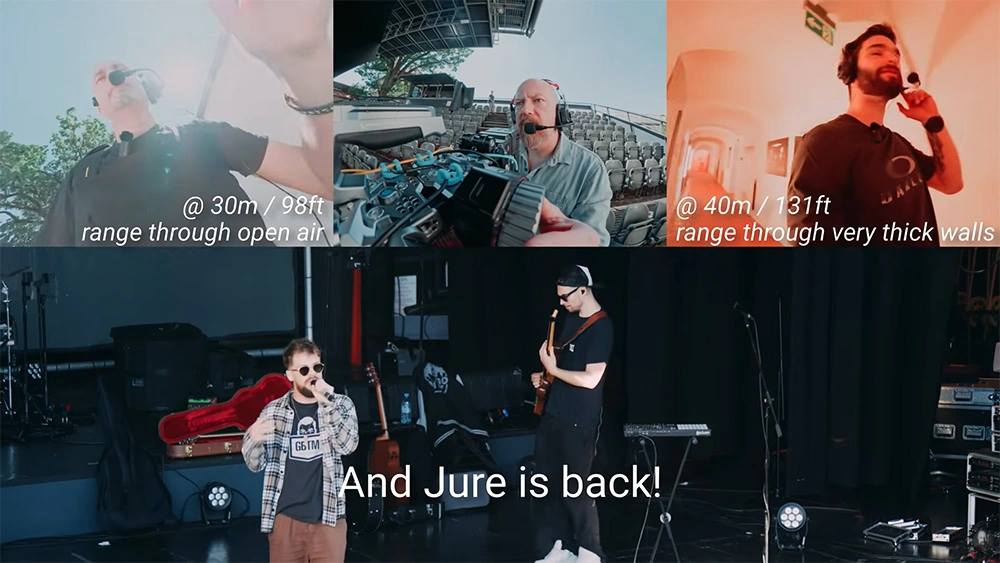
Unlike many range demonstrations that take place outdoors with a clear line of sight, this test was conducted inside a former monastery built with exceptionally thick stone walls and multiple isolated rooms.
"It's really thick walls."
Throughout the test, crew member Jure gradually moved farther away from the main shooting area, passing through backstage corridors, separate rooms, and different sections of the building while maintaining communication with the rest of the team.
As he moved deeper into the venue, the crew performed informal range checks, repeatedly confirming whether communication remained stable. Surprisingly, conversations continued even after multiple walls separated team members.
For much of the test, voice communication remained stable despite increasing distance and multiple structural obstacles.
Eventually, communication began to break up as he reached the far side of the building, but the system continued working considerably farther than many users might expect in such a challenging environment.
What makes this result particularly meaningful is that the venue represented a realistic production scenario rather than a controlled outdoor distance test.
For teams working in theaters, churches, convention centers, stadiums, or historic venues, obstacle penetration often matters more than maximum line-of-sight specifications.
Did AI Noise Cancellation Improve Communication?
AI Noise Cancellation is designed to reduce unwanted background noise and improve speech intelligibility.
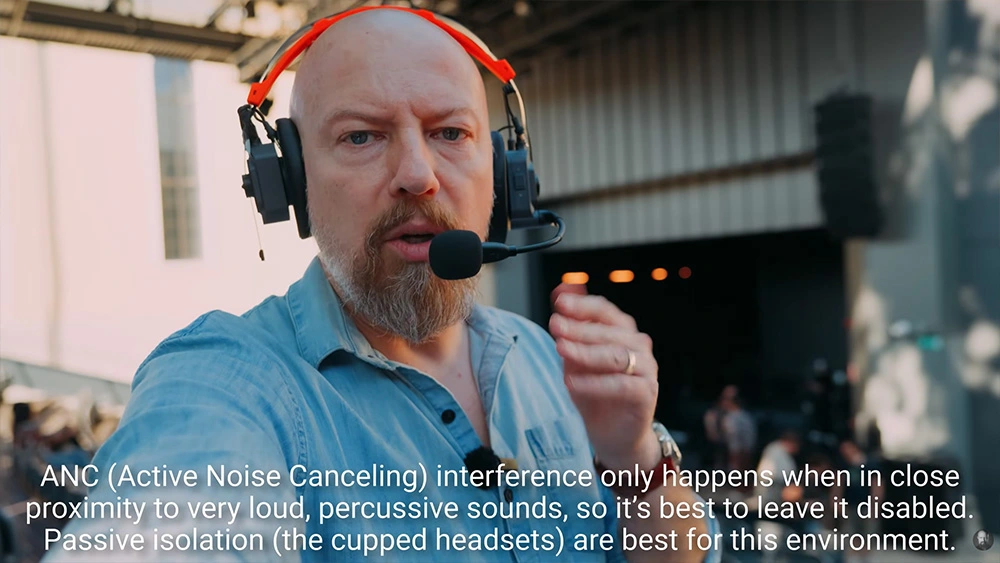
During the concert rehearsal, the crew experimented with the WiTalk9 X's noise reduction function while standing near drum kits, stage monitors, and PA speakers.
Interestingly, the team found that enabling or disabling noise reduction made little noticeable difference during the loudest parts of the rehearsal. Photo Joseph also pointed out that in extremely loud environments with highly percussive sounds, AI noise cancellation can sometimes affect the dialogue itself.
This observation aligns with guidance provided in the official user guide. During the test, Photo Joseph specifically noted that the documentation warns strong percussive sounds may affect noise reduction performance when users are positioned very close to the source.
The takeaway is not that AI Noise Cancellation failed. Rather, it highlights an important reality: no noise reduction system can completely overcome the acoustic challenges created by standing directly next to a live drum kit or high-output concert speaker.
For most production scenarios, the feature can still help reduce environmental distractions. However, in extremely high-SPL environments, headset positioning and communication discipline remain equally important.
In many ways, this was one of the most useful findings from the test because it reflects real-world expectations rather than marketing claims.
Who Is the WiTalk9 X Best Suited For?
Reliable crew communication is essential whenever multiple people need to coordinate in real time.
Based on this field test, the WiTalk9 X appears particularly well suited for:
- Film and video production crews
- Live event production teams
- Concert and festival operators
- Church and worship production teams
- Sports broadcasting crews
- Corporate event teams
- Multi-camera content creators
- Theater production teams
- Convention and exhibition staff
- Historic venue and large-facility operations
The system's ability to maintain communication in a venue filled with physical obstacles and high noise levels suggests it can handle many of the challenges encountered during professional productions.
For teams that frequently work in theaters, arenas, convention centers, historic buildings, or event spaces, practical reliability may matter far more than laboratory specifications.
Conclusion
"That to me is far more impressive than an outdoor range test."
This quote perfectly summarizes the outcome of the evaluation.
The most impressive part of this test was not the advertised range or the feature list. Instead, it was the WiTalk9 X's ability to maintain reliable communication inside one of the most challenging production environments a crew is likely to encounter. Between the loud concert rehearsal, thick monastery walls, and heavy digital activity throughout the venue, the system faced conditions that regularly expose weaknesses in wireless communication equipment.
For production teams looking for a wireless intercom system that can perform in real-world environments rather than controlled demonstrations, the WiTalk9 X demonstrated itself to be a capable communication tool when clear coordination mattered most.
The test ultimately showed that communication failures were more likely to be caused by physical barriers and overwhelming environmental noise than by wireless interference itself—a result that should give confidence to crews working in similarly demanding environments.
Most importantly, the test demonstrated something that specification sheets cannot easily show: how a communication system behaves when a production is actually underway. In that respect, the WiTalk9 X demonstrated that it can support effective crew coordination in challenging real-world production environments.
To learn more about the latest news from Saramonic, join in our official social media: Facebook, Youtube, Instagram, X, Facebook Group.
FAQ
Does the Saramonic WiTalk9 X work well in loud concert environments?
Yes. During PhotoJoseph's live concert rehearsal test, crew members were able to maintain reliable communication across most areas of the venue. The biggest challenge was environmental noise rather than wireless signal stability.
How far can the WiTalk9 X communicate in real-world conditions?
Operating on the 1.9 GHz frequency band, the WiTalk9 X minimizes interference from 2.4 GHz devices like Wi-Fi and Bluetooth, delivering stable communication up to 1,300 ft (400 m). The exact range depends on the environment. In this test, communication remained stable across multiple rooms and thick stone walls before eventually beginning to break up at the far side of the building.
Does AI Noise Cancellation help during live events?
It can help reduce background noise in many production environments. However, the test showed that in extremely loud situations—especially near drum kits and PA speakers—the feature offered limited benefits and could sometimes affect speech clarity.
What makes the WiTalk9 X different from traditional intercom headsets?
The WiTalk9 X features a modular design that supports single-ear, dual-ear, and helmet-ready configurations. It also includes A/B group communication, AI Noise Cancellation, dual-antenna transmission, and support for larger communication systems.
Is the WiTalk9 X suitable for film production crews?
Yes. The system is designed for film sets, live productions, sports broadcasting, corporate events, and other workflows where real-time communication is essential.
Can the WiTalk9 X be expanded for larger teams?
Yes. The system can operate as a standalone communication solution for smaller crews and can be expanded with the WiTalk BASE system for larger production environments.