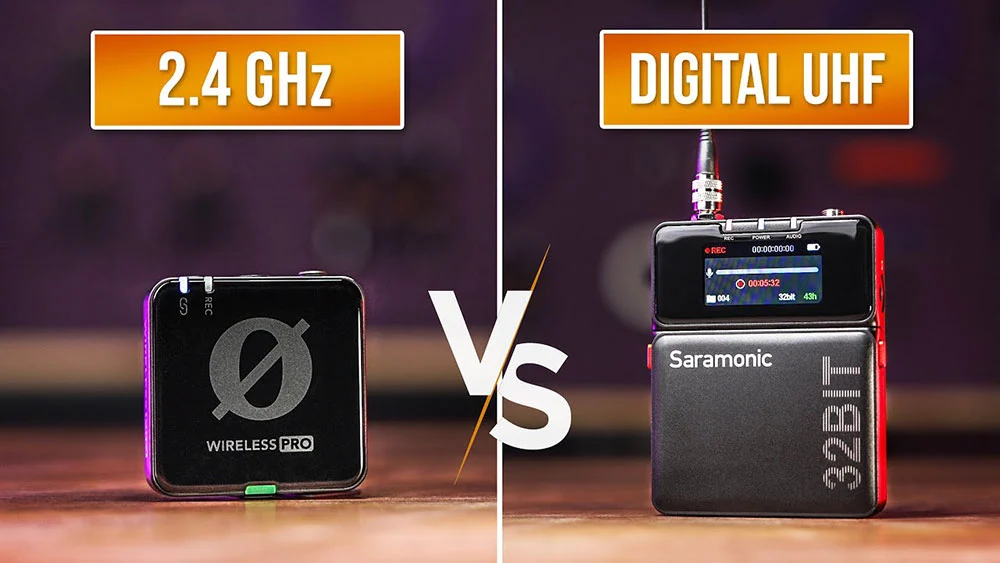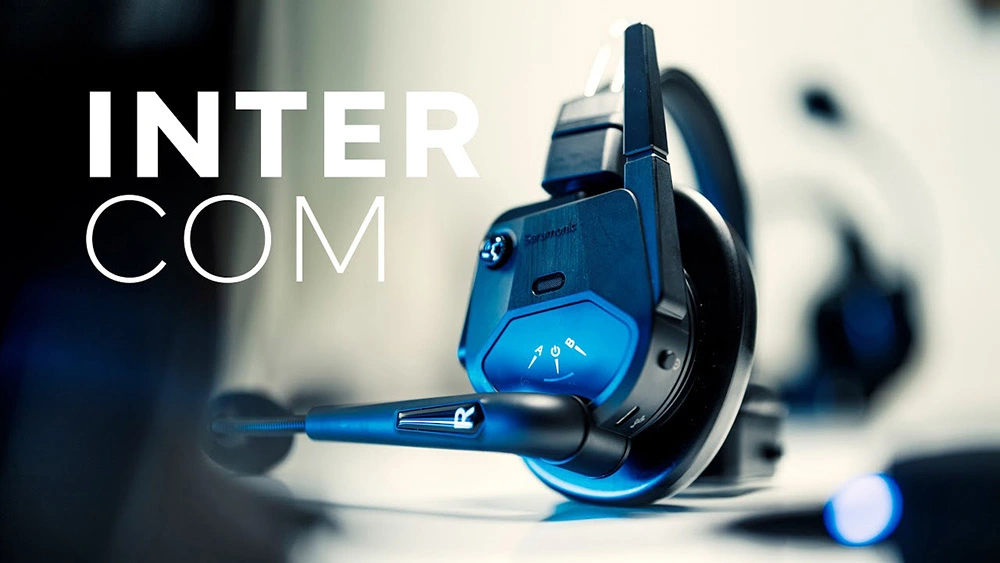



💡 Key Takeaways
- The lightweight 172g design makes all-day communication far more comfortable on set: Weighing only 172g and featuring an IPX4 water-resistant rating, the WiTalk 9X significantly reduces the neck strain and weather-related limitations commonly associated with traditional heavy production headsets.
- Industry-first modular architecture breaks the rigid form-factor boundaries of communication gear: Beyond hot-swappable ear cushions, the system allows users to seamlessly convert the same core unit between single-ear, dual-ear, and helmet modes to match different crew roles.
- On-board AI noise cancellation helps reduce distracting background chatter on noisy sets: By filtering out ambient mechanical and construction noise at the hardware level, the system helps maintain clear voice communication and reduces listening fatigue during long production days.
- Single-ear configurations hit a physical isolation ceiling in high-decibel environments: Due to the acoustic limitations of an open-ear design, the maximum volume output of the single-ear version can still struggle against ambient noise on extremely loud industrial sets.
Why More Film Crews Are Replacing Walkie-Talkies with Wireless Intercom Headsets
On fast-moving productions, communication inefficiencies can quickly slow down production workflows. For decades, traditional walkie-talkies have been the baseline for production crew communication, yet their asynchronous, push-to-talk (PTT) nature, persistent squelch noise, and heavy, belt-clip chassis frequently introduce unnecessary friction for fast-moving, small production crews. For small film crews, a wireless production communication system can significantly improve coordination efficiency on set. To solve this problem, understanding what is a wireless intercom headset system and how it establishes a continuous audio matrix is essential to evaluating its real-world superiority over old-school two-way radios.
Addressing this specific operational bottleneck, professional audio manufacturer Saramonic has rolled out the WiTalk9 X wireless intercom headset system. Positioned as a major upgrade to the original WiTalk 9 series, this new iteration introduces substantial weight reduction, hardware-level AI noise cancellation, and a highly versatile, interchangeable physical format. Evaluating the gear through the lens of independent filmmakers reveals how this modern setup transforms director/DP collaboration and small crew usage without the deployment overhead of traditional broadcast infrastructure.
Real-World Production Testing with a Small Crew
Long-Term On-Set Comfort Largely Depends on Headset Weight.
An ultra-lightweight 172g chassis makes long shooting days less physically demanding for directors and camera operators.
Film shoots are often long and physically exhausting, with standard shooting schedules regularly stretching from 8 to 14 hours. Traditional production crew communication headsets are notoriously bulky, causing noticeable neck fatigue for directors and camera operators, which often forces crew members to hang the units around their necks, leading to missed critical cues and delayed setups.
In real-world tests on a production set, filmmaker and reviewer Savage Skywalker highlighted the immediate impact of this ergonomic shift:
"The big change for these headsets is that they are much lighter at only 172 g, and therefore much less of an imposition for 8 to 14 hours on set all day than many other headsets."
In actual video production scenarios, this physical weight reduction makes crews more likely to keep the headset on throughout the day. Backed by an IPX4 water-resistant rating, the hardware ensures that if an independent crew gets caught in a sudden downpour during an exterior location shoot, there is no need to halt communication to protect fragile electronics. This level of hardware resilience allows small teams to maintain focus on the creative workflow rather than equipment maintenance.
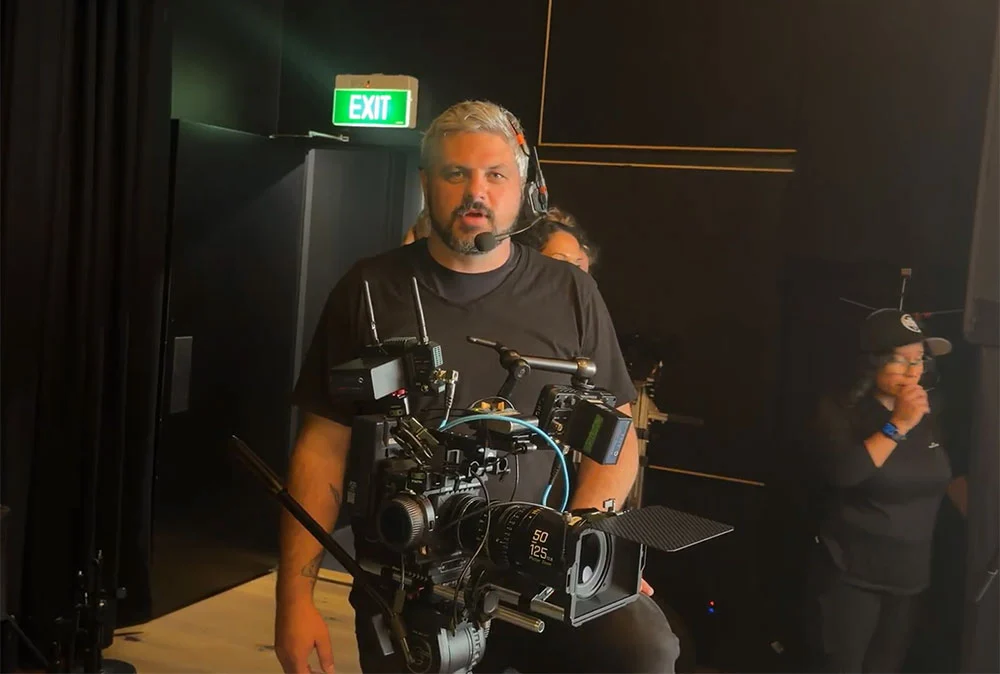
A Modular Intercom Design for Different Crew Roles
By enabling on-the-fly conversion between single-ear, dual-ear, and helmet modes, the WiTalk9 X adapts to specific operational environments instead of forcing users to buy multiple dedicated systems.
Different crew positions across a film set require completely distinct levels of situational awareness and acoustic isolation. A director sitting at a video village monitor might need complete dual-ear isolation to focus on performance nuances, whereas a DP operating a primary camera setup typically favors a single-ear headset to keep one ear open to the physical environment. Concurrently, a grip or crane operator working underneath heavy rig setups is legally and practically required to wear a safety helmet.
From a practical production standpoint, the modular architecture addresses these diverse requirements smoothly:
"It also should be noted that these headsets are completely modular, meaning you can replace parts of them without needing to replace an entire headset. Which means they're going to last longer and are more environmentally sustainable, which I do appreciate. And I appreciate the idea that I can just repair my headsets instead of having to buy all new ones. "
This approach represents a major step forward in field utility. Beyond allowing production assistants to quickly unclip and swap premium leather or breathable foam ear cushions for hygiene purposes between shoots, the modular system means the core transceiver can be detached and snapped into a single headband, a dual headband, or a dedicated hard-hat clip. This flexibility allows smaller production teams to adapt the same communication system to different crew roles without purchasing multiple dedicated headsets.
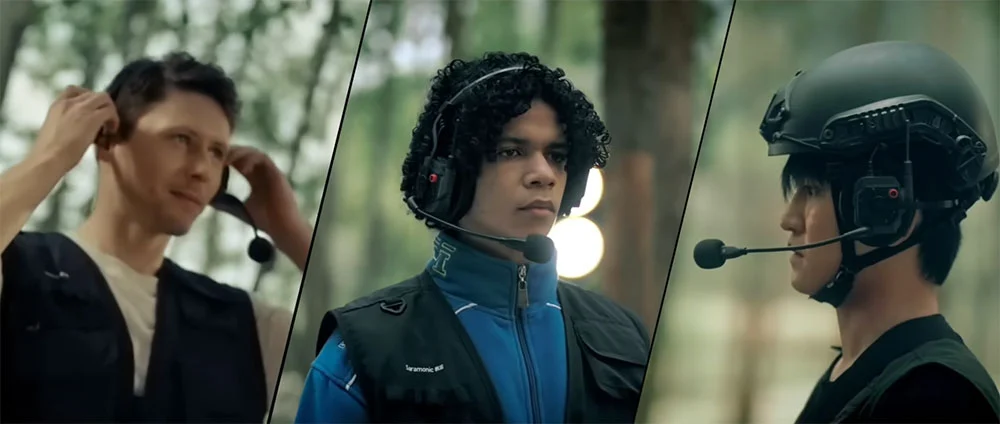
Base-Free Networking Simplifies Setup for Fast-Moving Crews
A base-free wireless setup removes the need for a central base station, letting independent directors bypass lengthy pre-shoot synchronization routines.
For agile 2-to-3-person commercial crews or independent documentary filmmakers, every additional piece of mandatory gear that requires independent mounting and external power extends setup times and slows down location scouting and quick turnarounds. Traditional intercom systems that mandate complex manual frequency coordination or a dedicated central hub can delay production before filming even begins.
When analyzing the crew workflow, field testing demonstrated that the WiTalk9 X is designed to work almost immediately after powering on:
"And what's unique about the 9X is it doesn't require a base station, although that is also available. Thus, bringing down the expense and bulk when bringing these to set. So, for me as an indie filmmaker, I appreciate that it's not another massive piece of kit to worry about. You just need the headsets. They come very conveniently in this bag, which houses everything. All you have to do is pull them out, put the batteries in, and go."
This base-free operating model aligns perfectly with the demands of modern small crew usage. The master headset and its slave units automatically connect as soon as they are powered on, establishing a stable full-duplex communication link over a 400-meter line-of-sight radius. Crucially, the system scales up to 9 headsets without an external hub, while maintaining an upgrade path to a 16-user network via an optional WiTalk Base station when transitioning to larger commercial assignments.
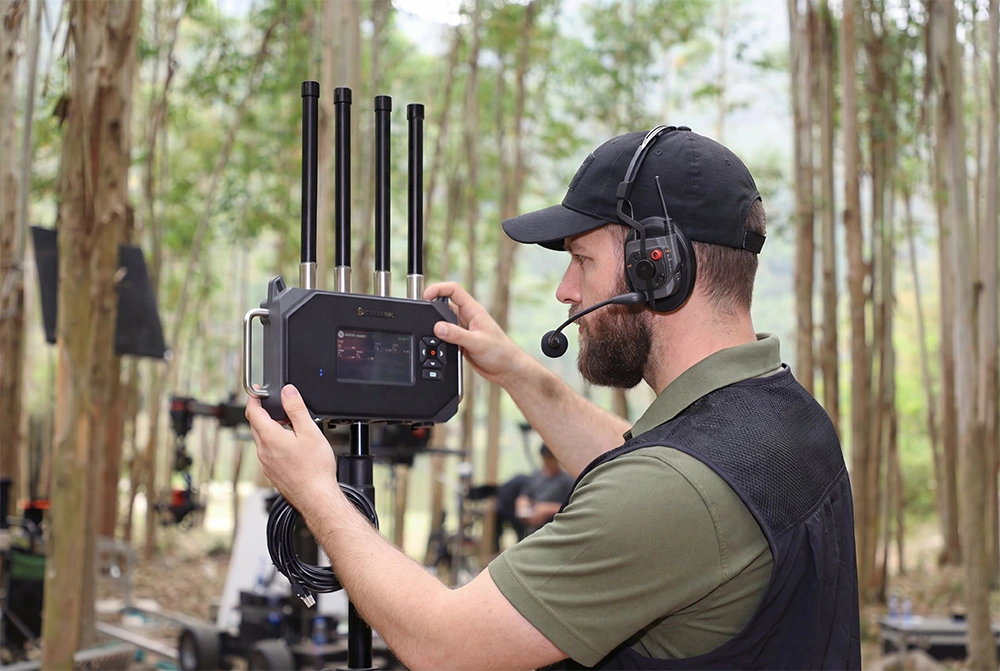
Full-Duplex Communication Makes On-Set Conversations More Natural
Simultaneous two-way talk coupled with intuitive physical controls enables precise, real-time crew direction without breaking the creative atmosphere of a set.
The single biggest walkie-talkie annoyance on an active film set is the intrusive walkie-talkie chatter—one person calls out a technical adjustment, and everyone within a 15-meter radius hears a burst of static and loudspeaker chatter, which easily distracts actors mid-take or bleeds into sensitive shotgun microphones. Full-duplex wireless networks allow crew members to communicate naturally in real time, replicating a real-time phone call and removing the awkward delay that usually comes with walkie-talkies.
Field application of the system during complex director/DP collaboration proved how a discreet audio loop preserves the focus of a set:
"And I think what makes headsets so good is that they can be very discreet. You're not projecting all this chatter over a walkie-talkie that can be heard by everyone. All that audio is just in your ear. If you want to say something, you can say it very quietly into your microphone. You don't have to announce it to the whole crew or have people overhear something that maybe you want to keep relatively private. "
When a director needs to quietly guide a DP to subtly reframe a shot, or tell a camera assistant to grab a different prime lens from the equipment van, the command can be whispered directly into the headset microphone, keeping the instruction localized and private. The interface leverages an ergonomic, flip-up-to-mute microphone arm alongside an oversized volume dial on the ear cup, making blind adjustments effortless even when the operator is completely focused on the camera monitor.
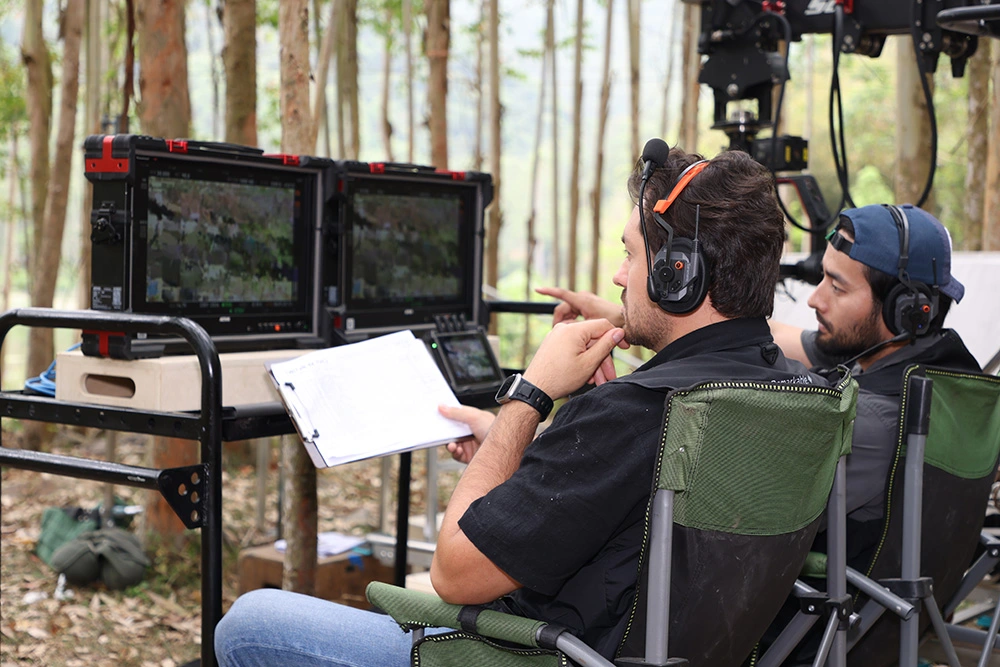
WiTalk9 X vs. Alternative Production Crew Communication Methods
| Evaluation Metric | Saramonic WiTalk9 X | Professional Production Walkie-Talkies | Consumer-Grade Bluetooth Intercoms |
|---|---|---|---|
| Single-Unit Operational Weight | 172g (Extremely low fatigue for 8-14 hour shoots) | 350g+ (Bulky chassis requiring a heavy belt clip and surveillance earpiece) | 50g-100g (Lightweight but requires external smartphone tethering) |
| Physical Adaptability | Modular Single/Dual/Helmet hot-swap conversion | Fixed physical form factor (Relies completely on external audio accessories) | Rigid consumer design; cannot integrate with industrial safety helmets |
| Communication Pipeline | Low-latency Full-Duplex (Simultaneous multi-user talk) | Half-Duplex (Single-channel push-to-talk with transmission lag) | Full-Duplex (High latency; prone to signal instability in crowded wireless environments) |
| Set Deployment Time | Factory pre-paired; zero-configuration startup | Manual channel-matching and squelch adjustment required | Complex smartphone app pairing; highly unstable in RF-heavy zones |
| Power Management & Supply | 9-12 Hours (Includes 10-bay charging dock and extra batteries) | 12-24 Hours (Heavy, thick proprietary battery bricks) | 4-6 Hours (Limited battery life during long production days) |
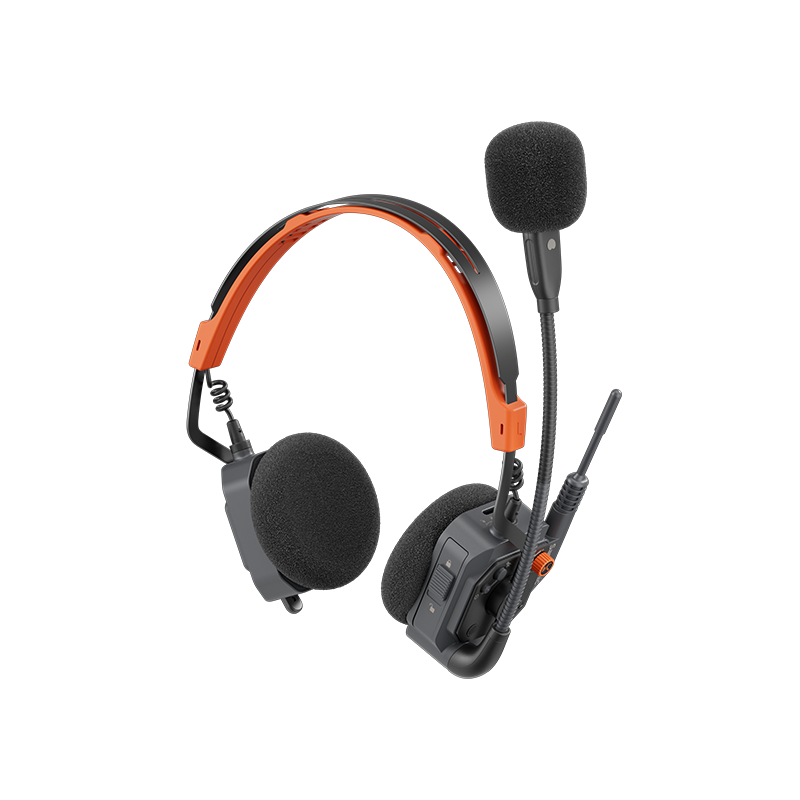
Editor's Notebook
While this wireless headset delivers clear operational advantages for smaller teams, an objective, balanced technical analysis requires highlighting the physical boundaries and conditions where even advanced wireless intercom systems can encounter issues. Understanding why wireless intercom systems break at scale ensures that technical directors build a reliable communication grid under heavy RF coordination stress.
The Single-Ear Acoustic Ceiling in High-Decibel Environments: Real-world set testing by working camera operators revealed a crucial nuance: even with the system's internal audio output cranked to maximum, a single-ear headset variant can struggle on exceptionally loud sets, such as live music recordings or heavy industrial locations. This is not a failure of the internal audio drivers; it is a basic physical constraint where the user's unshielded ear is being hit with high-decibel environmental noise.
Editor's Tip: If your production schedule frequently places you next to live drum kits, heavy machinery, or roaring exterior generators, utilize the system's modular architecture to switch to a dual-ear layout for proper passive acoustic isolation.
Unlocking "Tactical Mode" via the 2.5mm Audio Pass-Through: The top of the WiTalk9 X ear cup features a less common 2.5mm audio port (shipped with a 2.5mm-to-3.5mm adapter cable). This subtle design element offers a great alternative setup for hot summer shoots: if a director or producer dislikes wearing a traditional head-band headset for hours, they can clip the primary WiTalk9 X module directly to a belt or slip it into an interior vest pocket, then run the pass-through cable to a low-profile, in-ear monitor. This delivers an ultra-discreet, lightweight setup that is perfect for hosts who need to look clean on camera while staying connected to the director.
FAQ
Can the WiTalk9 X battery genuinely survive a full production day without shutting down?
Yes, field tests show it easily handles 10.5 hours of continuous, uninterrupted runtime during active production use.
While official specifications rate the lithium batteries between 9 and 12 hours depending on master/slave status, real-world stress tests with active, continuous communication proved the cells hold up past the 10-and-a-half-hour mark without dropping connection. Additionally, Saramonic includes a dedicated 10-bay charging station and 6 individual batteries in the standard 3-person package, ensuring three fully charged backups are always resting on the charger to prevent downtime.
Why is a full-duplex headset system fundamentally more efficient on a small set than a standard walkie-talkie?
It eliminates transmission latency and unwanted on-set noise, offering simultaneous two-way dialogue and improved on-set privacy.
Traditional walkie-talkies utilize half-duplex communication, meaning only one person can speak at a time while everyone else listens, often introducing a one-to-two-second delay for the radio channel to open. The full-duplex tech inside the WiTalk9 X allows the director, DP, and crew to converse simultaneously, just like a standard phone call. Furthermore, because the audio stays sealed within the ear cushions, it eliminates loud squelch or chatter from disrupting actors mid-take or bleeding into live production microphones.
How do I convert the WiTalk9 X from a single-ear setup to a dual-ear or hard-hat configuration?
You simply swap the headband assembly via the integrated quick-release mount without purchasing an entirely new headset.
Thanks to its modular engineering, the core transceiver unit, motherboard, and wireless antennas are isolated from the structural frame. If a production environment suddenly demands high passive noise isolation or strict construction safety helmets, the user unclips the core module from the lightweight single headband and slides it directly into a dual-ear headband or a dedicated hard-hat slot. This modular versatility significantly protects equipment investments for growing production houses.
Can the integrated AI noise cancellation be manually turned off, and how can I check its status mid-shoot?
Yes, it can be toggled via a dedicated physical button, and its real-time status is indicated by a clean color-coded LED.
To facilitate blind adjustments during fast-paced shoots, the headset features a physical button at the base of the microphone boom. Pressing it activates the hardware-level AI noise reduction, turning the indicator LED green. If an operator swings the microphone boom straight up into the vertical position or presses the secondary mute button, the LED instantly turns red, giving the rest of the crew a clear visual indication that the user is muted.