
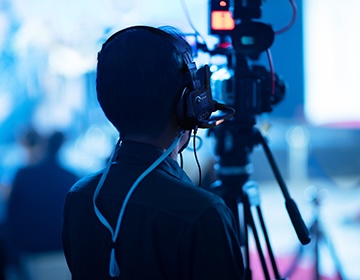
In today's high-stakes production environment, a wireless microphone system is more than just a tool—it’s the backbone of your audio workflow. As projects scale, the priority often shifts from chasing features to ensuring absolute reliability under pressure.
Based on field tests by tech expert Nori Ito, this guide moves away from spec sheets and into the practical logic of choosing the right system for your specific creative rhythm.
Selection Guide: Which System Fits Your Workflow?
| Model | Core Value Logic | Best For |
|---|---|---|
| Saramonic Ultra | Prioritizes signal integrity and IPX5 weather resistance in unpredictable settings. | Commercial shoots, outdoor expeditions, and high-interference areas. |
| Hollyland Lark Max 2 | Ultra-lightweight transmitter (TX) design with flexible receiver monitoring. | Fashion Vlogs, lightweight interviews, and solo creators. |
| RØDE Wireless Pro | Established 32-bit Float on-board recording with robust locking connectors. | Professional crews and documentaries requiring maximum post-production range. |
| DJI Mic 3 | High-efficiency magnetic ecosystem with 4-channel support for Sony MI shoe. | DJI users, fast-paced run-and-gun, and multi-person panels. |
Storage Case Comparison
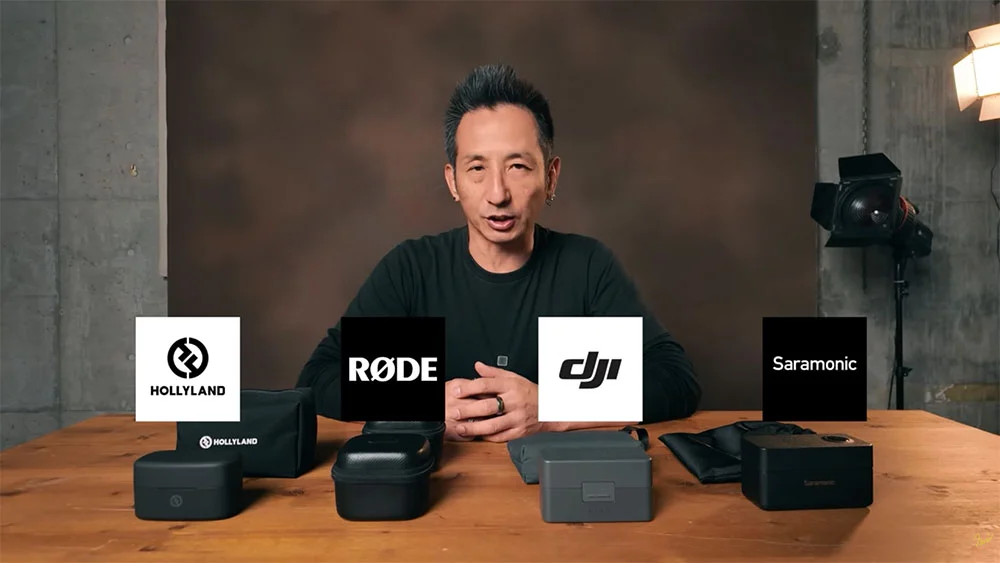
Storage design is about more than just portability—it dictates on-set efficiency. In the video, Nori Ito provides an exhaustive comparison of the charging cases and included pouches across all four flagship models.
The DJI Mic 3 received high marks for its premium all-metal charging case. The KOL particularly highlighted its high level of integration: "The storage for the DJI Mic 3 is exceptionally well-done. Even the 3.5mm cables and magnetic clips fit neatly inside the case, allowing you to head out to a shoot without needing an extra accessory bag."
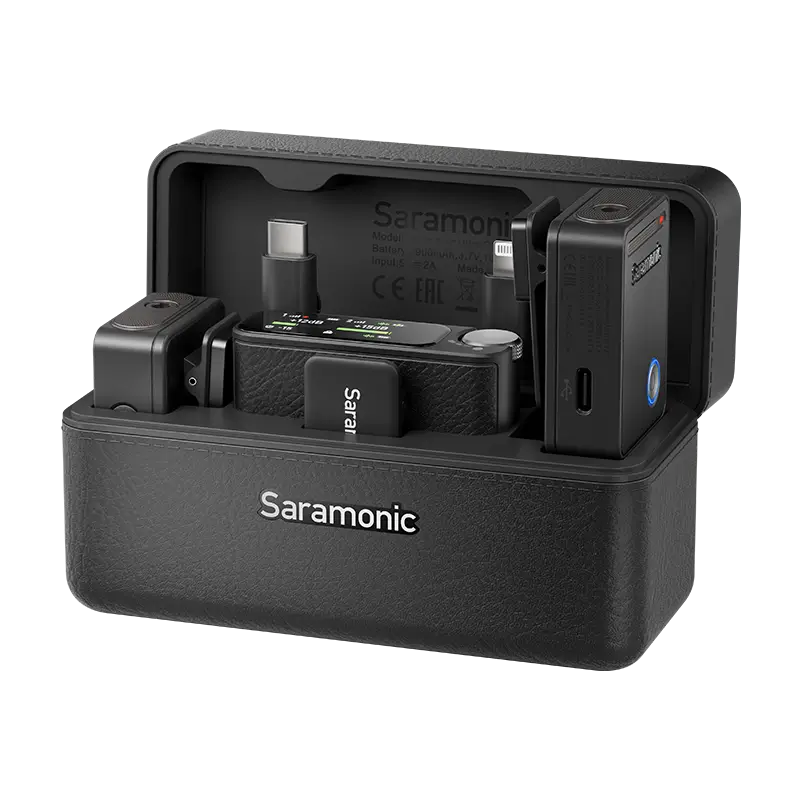
In contrast, the Saramonic Ultra follows a more rugged, "pro-field" design language. Ito describes the charging case as having a "plastic build but with a leather-like textured finish." While the Ultra and Hollyland systems both rely on an included carrying pouch to house accessories like lavalier mics, Ito offered a vital tip for professional use:
"Because the carrying pouch is quite spacious, I recommend using small sub-organizer bags inside to prevent small accessories from accidentally falling out when you reach for the charging case." — Nori Ito
Transmitter Ergonomics: Lightweight Comfort vs. Connection Security
When comparing wireless transmitters, it is no longer just about size—it’s about how they are worn and whether the connection is absolutely fail-safe.
While the Hollyland Lark Max 2 takes an ultra-lightweight magnetic approach, it involves some compromise on professional connectivity. The RØDE Wireless Pro and Saramonic Ultra, however, are positioned as true "workhorse" tools. Ito points out that while these units can be clipped on directly, their core strength lies in their role as a Wireless Bodypack for external lavaliers:
"For professionals, a 3.5mm threaded locking connector is essential. It ensures the lavalier cable is physically locked into place, meaning there is absolutely no chance of the mic accidentally falling out during a shoot." — Nori Ito
The ergonomics of the Saramonic Ultra left a strong impression during the hands-on test. Ito specifically noted the tactile experience of the hardware:
"When you hold the Saramonic Ultra, it feels very comfortable in the hand. The texture and the grip are excellent for professional use cases." — Nori Ito
Furthermore, the Saramonic Ultra stands out as the only model with a major durability advantage: IPX5-rated dust and water resistance on the transmitter. Ito emphasized this as a lifesaver in extreme conditions: "It's okay even if you get a little wet during recording in the rain, or even you are in the place with a lot of dusts fly around, it's completely fine."
Audio Excellence & Signal Stability
In the realm of high-stakes production, both the Saramonic Ultra and RØDE Wireless Pro offer a critical "insurance policy" through 32-bit Float on-board recording.
This 32-bit Float capability is a game-changer for commercial audio, allowing editors to recover clipped audio or boost whisper-quiet dialogue in post with zero loss in quality. While both systems provide this software-level safety net, their hardware philosophies for ensuring signal integrity differ.
The Saramonic Ultra stands out by combining this 32-bit internal recording with an external antenna system designed for maximum link stability. During field tests in complex environments—such as recording through concrete walls—the KOL noted the immediate psychological and technical benefit of the Saramonic Ultra's design.
While DJI and Hollyland lean toward aggressive AI noise cancellation for fast turnaround, Saramonic and RØDE prioritize preserving natural, high-dynamic range detail. The KOL emphasized that for professional results, the hardware-first stability of the Saramonic system is indispensable.
By integrating 32-bit Float recording with a high-resilience antenna-aided signal, the Saramonic Ultra provides dual-layer protection: it secures the audio data at the source (TX) while ensuring the transmission remains unbroken at the receiver (RX), making it a formidable rival to the industry-standard RØDE Wireless Pro.
Conclusion
There is no universally “best” wireless system—only what fits your environment, your risk tolerance, and your workflow. Saramonic Ultra is designed for the creator who prioritizes "fail-safe" operation. If your work takes you into unpredictable environments or RF-heavy locations, the Ultra's focus on signal stability and IPX5 durability makes it one of the most practical choices for this stage of your creative journey.
To learn more about the latest news from Saramonic, join in our official social media: Facebook, Youtube, Instagram, X, Facebook Group.
FAQ
Does IPX5 mean I can record underwater?
No. IPX5 means the device can withstand low-pressure water jets (like rain or splashes). It must never be submerged.
Which mic is best for professional commercial work?
If you need to recover audio from extreme volume fluctuations in post, RØDE is excellent. However, if you need to guarantee the signal never drops in a rainy or signal-congested environment, Saramonic Ultra is the stable solution.
Why does Saramonic use external antennas?
In crowded trade shows or obstructed outdoor terrain, an external antenna improves the link budget and reception stability, significantly reducing the risk of audio dropouts.