



💡 Key Takeaways
- Hub-free wireless intercom systems work well for small teams, but 8–10 users is a critical breaking point.
- Mesh topology does not scale efficiently—connection complexity grows exponentially.
- A wireless intercom hub (base station) introduces structure through grouping and centralized control.
- This is not an upgrade—it’s a system-level transition required for scalable communication.
From Seamless to Chaos: What Changed?
In small production environments, communication feels seamless. Everyone hears everything, and coordination happens naturally. But as your team grows, subtle problems emerge: interruptions, repeated confirmations, and missed instructions. Once you exceed 10 users, communication often collapses. Most teams blame signal strength or hardware—but the reality is simpler:
Your system isn’t broken — it was never designed for communication at scale.
The Common Mistake: Fixing Structure with Hardware
When communication fails, people upgrade gear: stronger signal, longer range, better headsets. But none of these solve:
- Multiple people talking simultaneously
- Cross-team interference
- Lack of communication hierarchy
This is not a hardware problem. It’s a system architecture problem.

Why Hub-Free Systems Break at Scale
Full-Duplex Amplifies Chaos
Full-Duplex communication allows all members to speak and listen simultaneously, providing a "face-to-face" natural experience in small teams. However, in the absence of structure, it also amplifies chaos. When three or four people speak at once, the "hidden burden" of processing information in the brain rapidly accumulates, leading to decreased attention and increased error rates.
No Grouping, No Structure
Imagine a director giving instructions, a lighting technician confirming brightness, and a camera operator discussing focus. If all this information is on the same channel, everyone's brain is doing extra work, constantly filtering "what information is relevant to me." Without grouping, communication loses its necessary hierarchy and efficiency.
Mesh Networks Hit a Limit
Most hub-free wireless intercom systems utilize a Mesh topology. In this structure, for every additional user, the number of connection links the system needs to handle grows exponentially. This is why once the number exceeds 8–10 people, latency and instability suddenly appear. Hub-free systems are not "scaling"; they are gradually reaching "saturation."
What a Wireless Intercom Hub Actually Changes
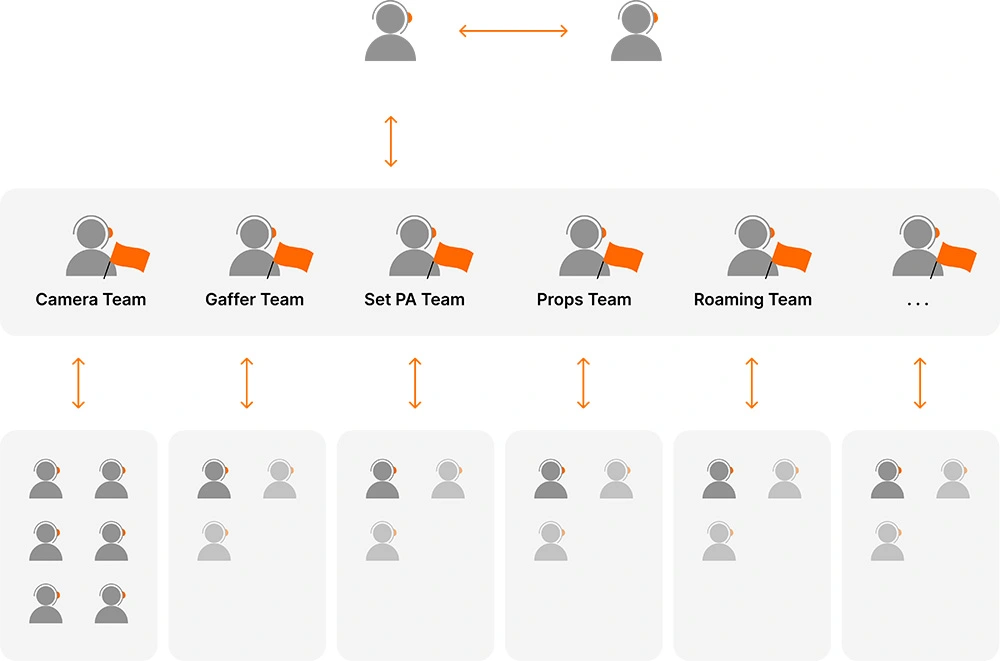
With the introduction of a base station, the wireless intercom system undergoes a fundamental change: from "everyone connecting to each other" to "everyone connecting through a central point." The core value of a base station is not simply to boost the signal, but to introduce structure.
- Group Management: Director teams, camera teams, and lighting teams can communicate independently while also being centrally coordinated. Information no longer interferes, and everyone receives only the information relevant to them.
- Central Control: You can set priorities (e.g., director has priority) and centrally manage member statuses. Communication shifts from "spontaneous" to "manageable."
- DECT Technology Advantage: Professional base station systems typically employ DECT (Digital Enhanced Cordless Telecommunications) technology. In high-load scenarios, their star architecture offers significantly greater stability than hub-free systems, with lower latency.
The difference is not signal strength—it’s structure.
Hub vs Hub-Free: Quick Comparison
The difference becomes clear when comparing system capabilities:
| Feature | Hub-Based System | Hub-Free System |
|---|---|---|
| Users | 10–50+ | 2–8 |
| Communication | Multi-channel grouping | Single channel |
| Control | Centralized | None |
| Topology | Star | Mesh |
| Scalability | High | Limited |
When Do You Need a Wireless Intercom Hub?
You Don’t Need One:
- Team ≤ 8 people
- Simple communication
- No grouping required
You’re Reaching the Limit:
If communication feels tiring, repetitive, or chaotic—you’re hitting structural limits.
You Definitely Need One:
- Team ≥ 10–12 people
- Multiple departments
- Large or complex environments
How to Choose the Right Base Station System?
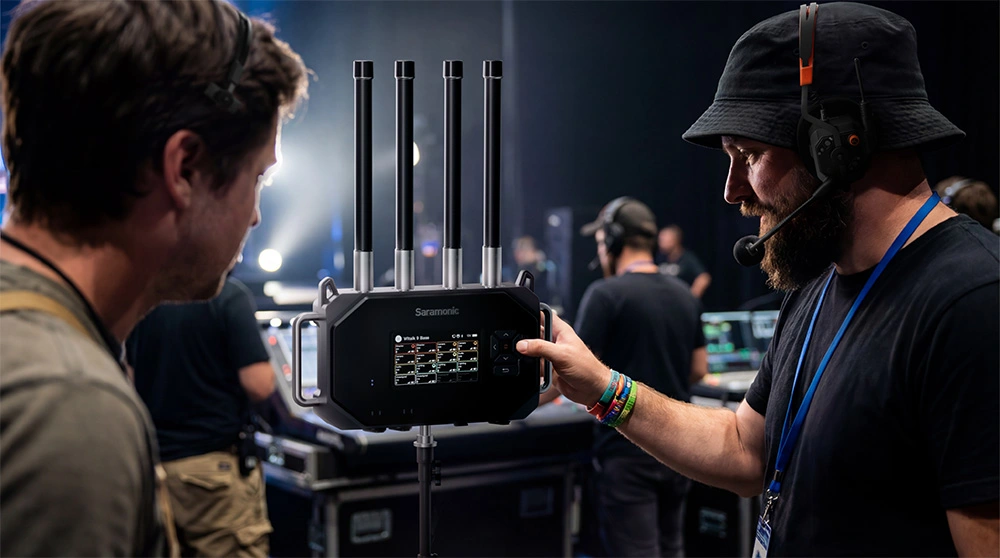
Once you've determined that you need a base station system, focus on these key aspects to select the best solution for your team:
- Supported Users and Scalability: Evaluate current and potential future maximum team size, and whether it supports cascading for expansion.
- Grouping Flexibility: Does it support enough groups to match your team's functional needs?
- Latency and Audio Quality: For professional applications, the low-latency performance of DECT technology is crucial.
- Connectivity Compatibility: Can it integrate with existing equipment (e.g., audio mixers, USB audio, wired intercoms)?
- Deployment Convenience: Consider power options (battery/PoE) and flexibility of on-site installation.
Saramonic WiTalk Base: A Professional Base Station Solution Example
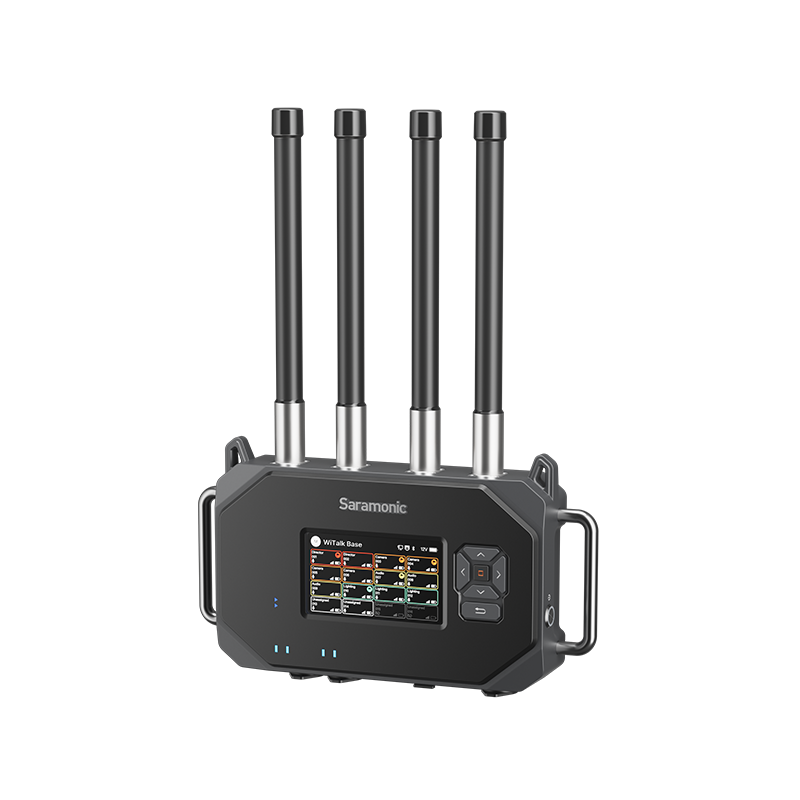
Among numerous base station systems, the Saramonic WiTalk Base offers a powerful, professional-grade solution that perfectly illustrates how a base station system addresses the communication pain points of large teams. The core advantages of WiTalk Base lie in its robust scalability, flexible group management, and exceptional stability:
- Massive Capacity and Flexible Expansion: A single WiTalk Base unit supports up to 16 simultaneous users, and through LAN port cascading, it can easily expand to accommodate up to 64 users, meeting the demands of ultra-large teams for major events or complex film productions.
- Refined Group Management: It supports up to 8 independent talk groups, allowing for precise allocation by role (e.g., director team, camera team, lighting team). Users can listen to two groups simultaneously and flexibly switch their speaking group, ensuring accurate and interference-free information delivery.
- Stable and Reliable DECT Communication: Utilizing 1.9 GHz DECT technology, it provides a reliable communication range of up to 700 meters. Even in complex RF environments or scenarios with obstructions, it maintains stable connections and effectively reduces latency.
- Broad Compatibility and Control: Offers a 4-wire analog interface for seamless integration with mainstream wired intercom systems like Saramonic WiTalk9 and WiTalk9 X. Additionally, centralized control via a Web/App platform allows for real-time system monitoring, simplifying on-site management.
- Rugged and Durable Design: Features a magnesium alloy chassis with IP66 dust and water resistance, ensuring stable operation even in harsh outdoor or challenging environments.
WiTalk Base is more than just a communication device; it is a "communication hub" designed for large-scale, high-intensity collaboration, transforming chaotic communication into efficient and organized team cooperation through structured management.
Conclusion
Most teams don't actively choose a base station system. They simply reach a stage where—If structure is not introduced, communication itself cannot continue. A base station is not just a "better headset"; it is the underlying architecture that allows the system to continue functioning efficiently when communication enters a complex phase.
To learn more about the latest news from Saramonic, join in our official social media: Facebook, Youtube, Instagram, X, Facebook Group.
Frequently Asked Questions About Wireless Intercom Systems
Can a hub-free system really not support more than 8 people?
Technically, you can try to connect more, but due to the limitations of Mesh structure, once the number exceeds 8-10 people, system stability will significantly decrease, latency will become very noticeable, and the communication experience will rapidly deteriorate.
Does a base station system increase communication latency?
This is a common misconception. In fact, in multi-person scenarios, a professional base station system based on DECT technology, due to its optimized star architecture, typically offers better stability and lower perceived latency than a hub-free system under high load.
Why is the grouping function so important for large teams?
Grouping enables "information isolation," allowing camera operators to hear only camera-related information, and lighting technicians to hear only lighting-related information. This reduces "filtering fatigue" in the brain and ensures critical instructions are not drowned out by noise.
When should multi-base station roaming be considered?
When your production site spans multiple floors, large venues, or has significant architectural obstructions, and a single base station cannot cover the entire area, you should consider a base station system that supports roaming.